Country garden planting schemes let you think big. City and suburban gardens are getting smaller all the time, which limits plant choices, but in a country garden you can use lots of big plants.
You can plant trees, shrubs and perennials in big groupings to achieve repetition – a great principle of garden design.
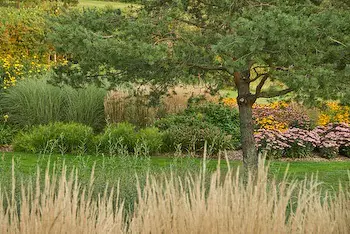
Beds dominated by grasses and perennials
Photo: © Y.Cunnington
More country garden planting tips:
Color schemes: In a small garden too many hot colors – vibrant reds, oranges and yellows – look busy, but in the country bold colors add excitement and variety.
Repitition creates drama: Mass plantings work well, as does limiting your plant palette – using plants in greater numbers. You can plant 35 Rudbeckia next to 25 ornamental grasses and have a dozen lilacs instead of just one or two.
Populate your flower garden with species that are easy to divide for increase, for example, yarrow (Achillea cultivars), Rudbeckia, lady’s mantle and daylilies. Division is an inexpensive way to fill up new beds.
Choose easy long-lived perennials: Daylilies, perennial geraniums, sedum, rudbeckia, coneflowers (Echinacea species), peonies, catmint, and ornamental grasses are all good for country garden planting.
Mix it up: Country garden planting styles often combine vegetables, perennials, cutting flowers and rose bushes, even fruit trees, into a mixed garden with pathways through it. Surrounded by an attractive fence this makes an appealing feature near the house.
Blend in with the surrounding landscape: You can showcase exotic trees and shrubs near the house, but as you move out toward wilder areas, switch to a palette of trees and shrubs native to your region.
Plant trees that grow big: Plant larger species such as native maples, ashes and oaks. Big evergreens such as pine, spruce and fir add winter interest and make good windbreaks. Trees, planted in lines, grids or placed informally into natural-looking groups, add structure and delineate the landscape. (How to plant a tree.)
Plant appropriately: Avoid putting a moisture-loving willow or birch tree in a hot, dry site. Remember that plants that have conditions they like don’t need a lot of fertilizer or watering once they are established.
Shrubs are terrific low maintenance plants: species with berries entice birds; try Saskatoonberry or serviceberry (Amelanchier species), mountain ash, viburnums, dogwoods and crabapples. Shrubs with bold leaf colors such as gold or dark burgundy add a touch of drama.
Country garden planting – maintenance tips:
- Incorporate trees into beds with shrubs and mulch on top of the soil with wood chips. This way you can avoid mowing or string-trimming around lone plants. Avoid mulch over landscape fabric – it doesn’t work well.
- Use fall leaves as mulch by collecting them and dumping them under trees and shrubs as mulch.
- Improve your soil by adding compost and manure. Most plants will grow well in rich hummusy soil that holds moisture.
- To edge your planting beds, use natural flat stone or large tumbled concrete pavers set into a shallow trench filled with crushed gravel.
- A country lawn doesn’t have to be perfect. If starting from scratch, choose low maintenance grass blends that are drought resistant. You can always get rid of lawn areas later, but in the meanwhile, lawn will keep weeds from overrunning your property.
- Mow near the house, but allow long grass at the periphery. Letting some grass areas naturalize and go to seed while nearby areas are mowed creates attractive lines in the landscape.
More Country Gardening Tips
Plant a wildflower prairie-style garden
Designing a country garden – more ideas
Read about Piet Oudolf’s new wave planting style:


