Delicate-looking snowdrops: You know that spring has finally arrived when you see these little bulbs in bloom -: they’re among the first flowers to emerge each season.
Their white flowers often appear before the last snow melts, but they easily weather the chilly days of early spring. The flowers are small, but unique, made up of three longer white petals covering three inner petals tinged with green.
Common species and cultivars
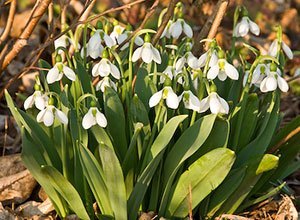
The earliest spring flowers
Giant snowdrop (Galanthus elwesii)has 1-1/2-inch flowers on 12-inch long stems above blue-green leaves.
Common (G. nivalis) has 1-inch blooms on 4 to 6-inch stems.
G. nivalis ‘Flore Pleno’ has double flowers and the outer and inner petals of G. nivalis ‘Viridiapice’ are tipped with green.
Planting and care:
Where to plant: These bulbs grow best in soil that is moist, but well drained. Give them a spot in full sun to light shade. They are excellentnaturalized under flowering shrubs and are lovely in woodland beds and rock gardens.
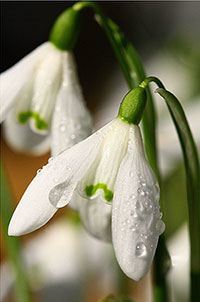
Flowers up close
Plant them close to the house where you can enjoy them when the weather is still too cold to venture into the garden.
Planting depth and spacing: Set bulbs 5 inches deep from the base of the bulb and 2 to 3 inches apart in early fall. Don’t let bulbs dry out; plant as soon as possible after buying.
Dividing: These little bulbs will self-sow, but they don’t multiply as quickly as crocus or scilla.
The best way to get more of them is by digging clumps up, being careful not to damage the roots, and dividing them into smaller clumps of at least six bulbs or more. Replant promptly, being careful not damage the leaves.
More About Flowering Bulbs
Try these usual spring bulbs: most are great for naturalizing
Early spring color with crocus
Spring-fresh tulips to brighten your garden


