Gypsy moth caterpillar infestations can ruin your backyard shade trees for the season. These voracious caterpillars are found mostly in north-eastern United States and southern Ontario.
The caterpillar problem grows in waves, getting worse as the population builds over a number of years to the point where they can defoliate entire forests in early summer.
Caterpillers stress trees
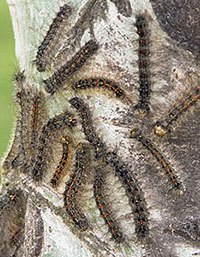
Gypsy moth caterpillars at rest during the heat of the day
An infestation of caterpillars isn’t necessarily fatal to trees, but it can contribute to their decline.
Leaf loss early in the season means that trees have to use a lot of energy to grow a second set of leaves.
If they suffer this stress on top of many seasons of heat and drought, they can begin to decline and eventually die.
After a massive infestation, predator populations rise, and the caterpillar infestation declines.
Then tree lovers can breathe a sigh of relief for a few years – usually about a decade.
Caterpiller control tips
Manual controls
Here are some simple control methods to help spare your trees and keep your backyard livable in times of heavy infestation:
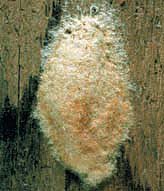
Gypsy moth egg mass
- Eggs are laid in branches and trunks of trees and they are buff colored spots about the size of a quarter or bigger.
- In the off season, examine your trees, and scrape off and destroy all egg masses you can reach. This helps to reduce the number of caterpillars that hatch.
- Don’t just scrape them onto the ground; instead burn the eggs in your fireplace, or drown them in soapy water and flush them away.
- Watch for small caterpillars in late spring. A garden hose has enough water pressure to knock them off leaves and tree trunks and kill them, especially when they are very small.
- Trap male moths by hanging pheromone (sex hormone) traps
on the trees. These traps act as decoys and prevent male moths from mating with females. - Fold a piece of burlap in half lengthwise and wrap it around the tree trunk. The caterpillars feed at night and crawl into the burlap fold to escape the heat during the day. Collect and destroy caterpillars each afternoon. If you’re not too squeamish, you can squash them or hand pick and drown them in a bucket of soapy water. Insecticidal soap sprays also kill them when they are small.
Effective insecticides
- In severe infestations, apply the biological insecticide Bacillus thuringiensis kurtsaki or Btk. This natural organic insecticide kills gypsy moth caterpillars, but is only effective when they’re quite small.
- The ideal time to apply Btk is when the bridal wreath spirea shrub is in bloom. For it to work, it must be ingested by the caterpillars when they’re very young, just as they start to feed. After they take the Btk bacteria in, they get sick, stop feeding and eventually die. Btk is harmless to people, pets, spiders, birds and bees.
- If you don’t spray at the right time, you may as well not bother: BTk is not effective when the caterpillars are as big as the ones in the picture at the top of the page.
Alternatives to insecticides
Pheromone products are formulated with the gypsy moth sex pheromone (like the traps mentioned above) and are effective at reducing mating encounters between adult moths. Fewer mating encounters means fewer moth eggs, translating into fewer caterpillars that harm trees.
SPLAT GM™ and SPLAT GM Organic™ are biodegradable mating disruption products that have been approved by and are used annually by the USDA Forest Service.
Related Information
Controlling garden pests naturally
What to do about Japanese beetles
The US Department of Agriculture Forest Service Gypsy Moth Site


