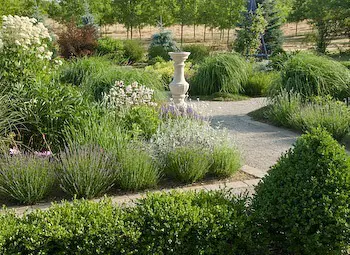
Well designed country garden in early summer. Photo: © Y.Cunnington
Did you dig in without considering garden design when you were starting out? That’s what I did. I just kept making my beds a little wider each year to put in more perennials. It was a matter of learning by doing.
Like most gardens (yours too, I’ll bet) my first one grew, bit by bit, without an overall plan. But now I believe any landscaping project is going to be more successful if you think it through first.
By the time I got to my second garden on an acreage, shown above, I did draw up a plan. The project was so big and had so many parts that we had to take quite a bit of time to consider what to do with each area before we started planting.
Do I have to get a design on paper?
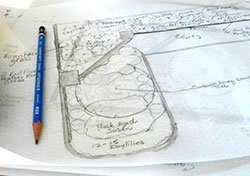
Designing on paper Photo: © Y.Cunnington
No, you don’t have to draw out a plan, showing where every single perennial plant goes.
I was trained in garden design, and most of the time I don’t have the patience for that!
The pros do it to figure out the exact number of plants to order, but home gardeners usually don’t work that way.
When I make a drawing for myself, it’s generally a simple one to show the layout of a bed, and a basic planting plan that shows the most important plants only.
A logical planting scheme to follow
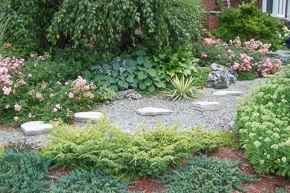
This city garden incorporates trees, shrubs,
evergreens and perennials into a pleasing design
Many people see gardening primarily as getting color into their yards for the summer season.
But if you focus on colorful flowers first and foremost, it’s a bit like arranging the lamps, accessories and pictures before your house has got its roof on.
Your best design guideline
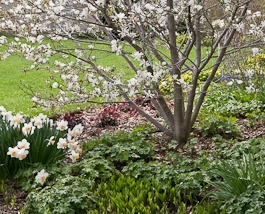
This star magnolia was planted first,
followed by pretties: perennials and bulbs
I once took a landscape design course taught by the British garden guru John Brookes, author of John Brookes Garden Design.
He advises planning and planting in the following order: First, the “specials”, usually large deciduous trees that serve as focal points; next the “skeletons,” evergreens or hedges for year-round structure.
Then come the “decoratives”, flowering shrubs or tall grasses. And, finally, you get to the “pretties” – spring and summer-blooming perennials and fillers such as bulbs, annuals or biennials. According to Brookes, many gardens lack structure and coherence because they were started with the “pretties.”
Getting started: Helpful tips
Planning your flower garden is a way to avoid the classic dilemma: wandering around with the plants you’ve just bought, wondering where the heck to plant them. Remember, give yourself time – nobody creates a prize-winning flower garden the first year.
Basics – Garden style, island bed or border, sun or shade?
Flower garden planning tips – Bed width, spacing of perennials, garden accents and focal points
Color in the garden – How to create great color schemes
MORE GARDEN DESIGN
All-season bloom: Plant a garden that’s colorful from spring to fall
Tips for hiring landscape professionals
Do you have an acreage? How to plan your country garden design
Helpful design books on creating a garden
Do you have allergies? Choose your plants with pollen counts in mind


