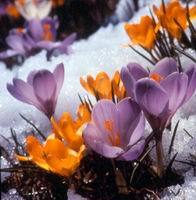
Cheery crocuses are synonymous with spring. They are tough plants, often blooming in the snow. Flowering in an assortment of spring colors, they brighten the mood of winter-weary gardeners.
Types to consider for your garden
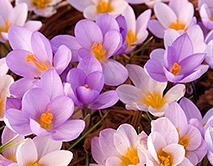
Cheerful spring blooms
The common hybrids have about half a dozen flowers per bulb and they bloom about a week or two later than species types.
When buying in the fall, you will find the following available: Dutch hybrids, generally from Crocus vernus, and the wild species, C. chrysanthus and C. tommasinianus.
The wild species don’t grow as tall, but they produce more color blends and have many more blooms per bulb, up to 20.
Crocus flowers are fair weather bloomers, opening only on sunny days. If it’s cloudy or rainy, they stay closed. They also close up at night.
Where to plant
These bulb flowers look good anywhere in the garden, but because they’re small you will enjoy them more if you plant them near the house or next to accessible pathways. Sometimes it can be too wet or muddy to venture further into the garden to enjoy these first flowers.
They are attractive under deciduous trees, in the front garden surrounding shrubs, at the edge of a perennial bed or in a rock garden setting.
You can also plant the bulbs in your lawn and allow them to naturalize. Combine them with other early blooming bulbs, such as snowdrops or Dutch iris (Iris reticulata).
Planting and care tips
Cosmos – an easy annual for beginners
Look for plump, firm bulbs and plant in full sun to part shade in well-drained soil. Plant bulbs 3 to 4 inches deep and the same distance apart. (More bulb-planting tips.)
These bulbs are trouble-free and easy to grow, but squirrels like to steal them.
Foil the furry pests by placing a screen of chick wire over your bulbs and then cover with soil; the bulbs will grow through the screen.
After blooming, allow the leaves to turn yellow and die back naturally.
CHOICE CULTIVARS TO TRY
Although you may find only two or three types at your local garden center, many more varieties and cultivars are available by mail order or through on-line catalogs.
Crocus chrysanthus
‘Cream Beauty’ – creamy yellow flowers with bright orange stamens
‘Jeannine’ – bronzy interior with light yellow exterior brushed with plum purple coloring
‘Ladykiller’ – outside petals are purple violet with white edges and interiors
‘Prins Claus’ – white flowers with oval blue blotch on outer petals
‘Snow Bunting’ – creamy white with pale blue-grey feathering on the outside
Crocus tommasinianus (these naturalize well)
‘Albus’ – creamy white form
‘Barr’s Purple’ – large, rich, amethyst-violet on the inside
‘Pictus’ – rounded, overlapping violet petals with darker purple tips, a white heart and yellow/orange stamens
‘Ruby Giant’ – reddish purple; almost one solid color
Crocus vernus cultivars
‘Enchantress’ – soft, pale blue flowers with a silvery gloss inside petals
‘Jeanne d’Arc’ – large, pure white with small purple base and bright orange pistil
‘Remembrance’ – rounded, violet flowers with a silvery gloss and a very dark blue base
‘Vanguard’ – light mauve/purple, rounded petals with shades of grey
More Spring Bulbs
Snowdrops – delicate, but tough harbingers of spring
Daffodils for more spring color
Unusual bulbs that should be better known
What do after your bulbs finish flowering


